
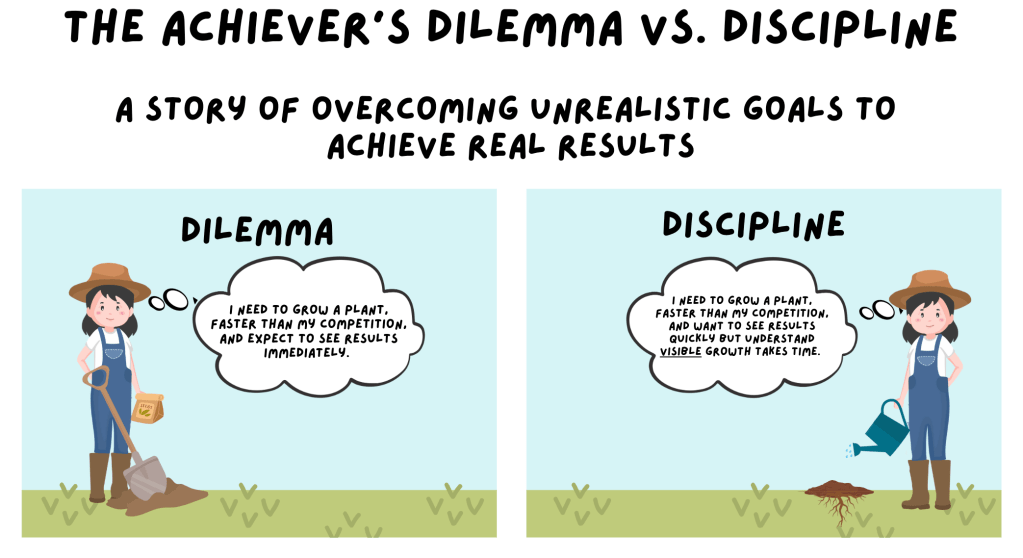
At Growth By Design, the belief that intentional choices spark impactful growth is at our core – whether sculpting a thriving organization or designing a fulfilling life. This is a space for tools, frameworks, and candid stories that actually move the needle. Today, a topic close to every high-achiever’s heart: the real art of patience in the pursuit of lasting results, and the subtle signals wise leaders use to judge timing – knowing when “too long” is too long, and when it’s simply “not long enough.”
Getting Antsy?
Lately, I’ve found myself wrestling with restlessness. The past three months have been a marathon of “seed planting” – pouring effort into visions for the future, hoping for sprouts that haven’t yet broken ground. My patience has worn thin at times, and my inner achiever’s drumbeat to outperform only makes the waiting harder. The unfortunate paradox I’ve created? The more seeds I plant, the stronger my impatience grows.
On my daily walks, as I pace through the tension of waiting, I remind myself of a universal truth – growth first begins beneath the surface. We often miss the roots fanning out beneath the surface, frustrated by the lack of visible progress, and abandon our work before it ever has a chance to bloom. How many times have leaders pulled up the seedling to check for roots, only to kill its potential?
Stop Over-Indexing on Failing Fast
In my work, I’ve seen too many leaders halt an initiative or swerve strategies far too soon. Sometimes, worst of all, they don’t fully commit in the first place. As a strategy leader, this is not just mind numbing, it is painfully disenchanting. That impatience doesn’t just fuel discontent and stagnate teams – it also suffocates the innovations that could’ve flourished with just a little more patience. The irony? When we bail out early, urgency costs us more time in the end, as we cycle through attempts without ever waiting for results to mature.
Research backs this up: according to a researchers Heracleous and Bartunek of The Travistock Institute of Human Relations, more than 70% of organizational change initiatives are abandoned before meaningful results can be measured. YIKES! Psychologists point to the “premature abandonment bias” – the tendency to underestimate the time needed for genuine progress and overestimate early setbacks, especially in complex systems. This bias is compounded by our internal narratives and social pressures, making patience feel less like a virtue and more like a liability.
Impatience is the Achiever’s Blindspot
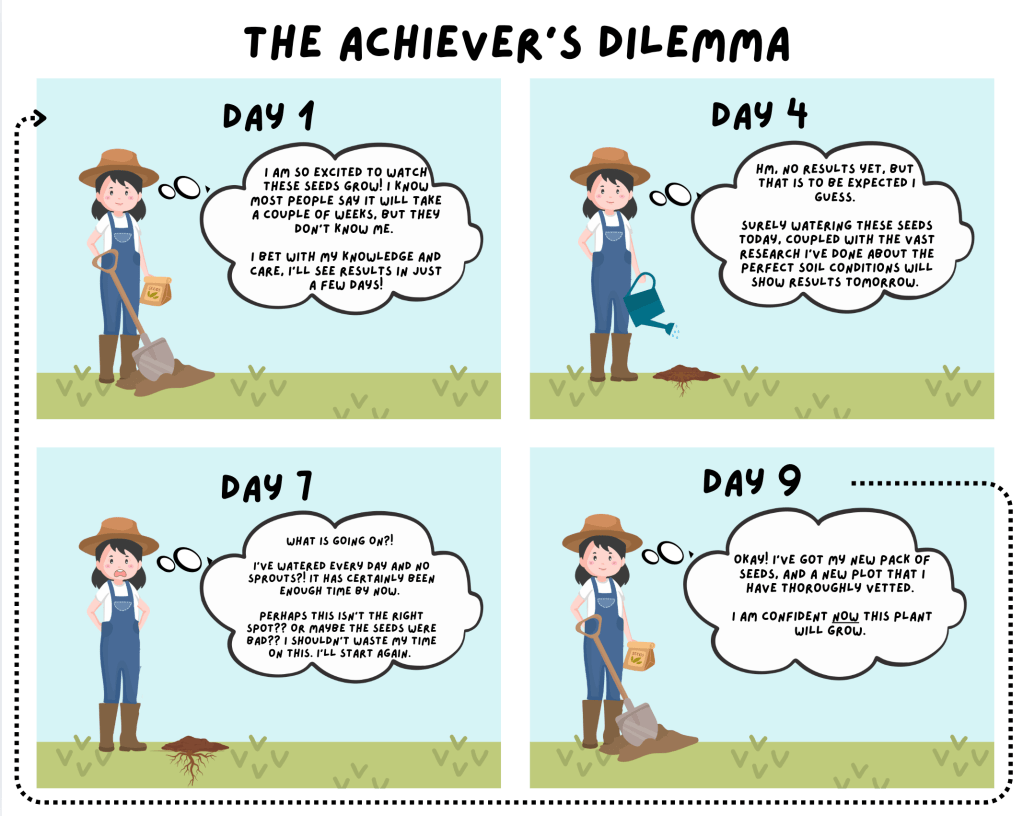
Achievers love bold visions and crisp benchmarks – I can say this as I am a very active member of the Achiever Club. But our greatest hazard is abandoning benchmarks before they’ve had a real chance to teach us. On the flip side, there’s the sunk cost fallacy – staying too long with something that’s truly not working. Yet, let’s be real: most high achievers err on the side of impatience, expecting results not just fast, but exponentially faster than reason predicts.
This is how promising projects get left behind, and teams scramble to explain mysterious failures when, in reality, the only villain was impatience. If you recognize yourself in this “Achiever’s Dilemma,” hi friend – you’re in very good company.
I did my best cartoon shorthand to visualize the Achiever’s Dilemma: roots thriving underground, while the impatient “farmer” despairs, thinking nothing’s happening simply because nothing’s visible.
The Achiever’s Discipline
So how do we balance failing fast with actually giving seeds enough time to grow? There’s no universal formula, but I do think it starts by transforming your Achiever’s Dilemma into an Achiever’s Discipline. The discipline is in checking the facts: What is the industry standard for results? What do objective metrics say? What forward movement can be tracked, even if the outcome isn’t visible yet? How about shifting focus to nurture secondary efforts while the main initiative digs its metaphorical roots?

Growth is Universal, But Still Feels Lonely
The Baader-Meinhof Phenomenon – more commonly known as frequency bias (e.g., you buy a red car then see red cars everywhere) – has been oddly comforting lately. Once I started noticing how common this pattern was in my own life, I saw it everywhere. Friends, colleagues, even the organizations I admire, all planting seeds in hopes of future fruit, all feeling that same restless uncertainty.
Oddly, it wasn’t until I opened up about my own impatience, languishing, and self-doubt that I recognized something crucial: this experience is almost universal – but we only see that once we’re brave enough to share. Suddenly, I found myself surrounded by fellow travelers on the same uncertain path, all quietly tending to roots beneath the surface and waking up each day hoping to see even a single sprout.
Boldness and Discipline Go Hand in Hand
We’re so often searching for silver bullets – looking for that “Jack and the Beanstalk” moment of explosive growth. But behind every overnight success lies a long trail of experimentation, failure, discipline, and resilience. The pursuit of quick wins can be just as dangerous as sticking with a truly failing project. The true art is the discipline to discern the difference between when is too long and when is not long enough.
You don’t have to abandon bold, audacious goals for the sake of patience. Nor must you chain yourself to every project until the end of time. Instead, strive to master the wisdom of timing: knowing when “enough” is truly enough.
“Patience is not passive; on the contrary, it is concentrated strength.”
– Bruce Lee
Action Steps for Leaders
To embody the patience that pays off, consider:
- Reflect and recalibrate. Regularly review data and stories, both to celebrate unseen progress and to identify true dead-ends.
- Set realistic timelines and communicate them. Growth takes longer than almost anyone expects.
- Track root-level progress. Don’t just measure top-line outcomes – look for subtle shifts, team learning, and early indicators.
- Foster psychological safety for vulnerability. Encourage sharing feelings of uncertainty or impatience to normalize them in your culture.
- Pause before pivoting. Implement a “wait period” before making significant changes to give initiatives a fair chance.
In sharing this – imperfectly and vulnerably – I hope it’s a reminder that most of the time, the seeds you’ve planted are quietly growing their roots. Growth happens first below the surface, out of sight, and often for much longer than we’d like. May we all keep planting, tending, and learning together.
Onward and upward!
Katie
 Growth By Design
Leave a comment